 English
English
English
 English
Updated on 07.09.2026
Starting September 15, 2026, fixed I-94 expiration dates will replace the previous “Duration of Status” principle for F, J, and I visas. Those affected must carefully note these deadlines in the future and, if necessary, apply for a status extension in a timely manner.
Share article:
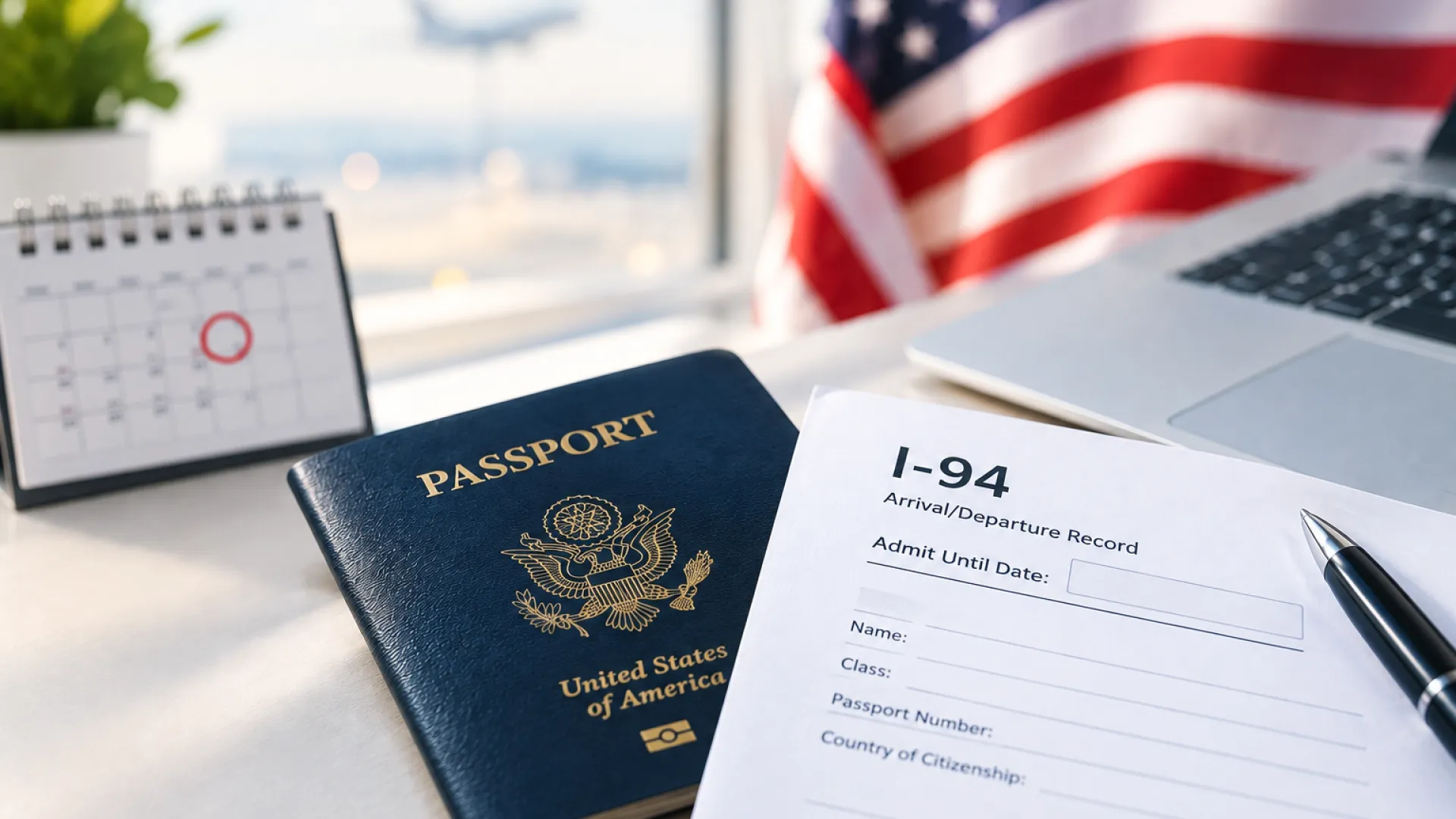
The planned abolition of the “Duration of Status” (D/S) regulation, scheduled for September 15, 2026, has been temporarily blocked by a court. The current D/S provisions will therefore remain in effect for the time being.
As of September 15, 2026
Last year, we already reported on the planned Abolition of the “Duration of Status” Principle reported on F, J, and I visas. At that time, it was still a proposed regulation by the Department of Homeland Security (DHS).
The actual implementation is now imminent: Starting September 15, 2026, new regulations will apply to international students, exchange program participants, and foreign media representatives. The current “Duration of Status” (D/S) will be replaced by a specific expiration date on the I-94 form. Below, we explain the changes this entails and what those affected need to be aware of going forward.
Until now, F-1 students and J-1 Exchange Visitors upon entry into the US, these individuals are generally granted the so-called “D/S – Duration of Status.” Thus, no fixed expiration date for the status was recorded on the I-94; rather, these individuals could generally remain in the US for as long as their valid I-20 or DS-2019 indicated and as long as they properly maintained their respective status. If the course of study or exchange program was extended, the I-20 or DS-2019 could be extended accordingly, without this alone requiring a separate application to extend stay with USCIS was required in the United States. A new I-20 or DS-2019 issued by the respective educational institution or exchange organization, in combination with a “D/S” notation on the I-94, thus served as proof of legal residency status.
It is precisely this flexibility that is now being eliminated: Starting September 15, at the I-94 A specific “Admit Until Date” has been entered. Effective immediately, this date is based on the period specified on the I-20 or DS-2019 form—that is, the specific duration of the academic program, exchange program, etc. If the academic program, language course, or internship (depending on the category) is to be extended, an “Extension of Status” (I-539) must be officially filed with USCIS in a timely manner. Alternatively, the individual may depart the country and, upon re-entry, be granted a new period of stay, provided that the I-20 or DS-2019 was updated.
For F-1 In addition, the grace period for students following completion of the program for new admissions will be reduced from 60 to 30 days. For the J category, the grace period generally remains at 30 days.
Holders of I visas — in particular correspondents, journalists, and other representatives of foreign media—are equally affected by this new regulation. Until now, the “D/S principle” generally applied to them as well. As long as the requirements for I status were met and the qualifying (journalistic) activity continued, they could remain in the US without a predetermined end date.
In the future, the visa granted upon entry will I Status is generally limited to a maximum of 240 days. The I visa itself can still be issued with a validity of up to five years. However, anyone who wishes to remain in the US beyond the period of stay specified on the I-94 must, in the future, apply for an extension of their status in a timely manner or leave the US in order to obtain a new status upon re-entry.
A special rule applies to nationals of the People's Republic of China: For them, I status is generally limited to a maximum of 90 days. Holders of passports issued by the Hong Kong and Macau Special Administrative Regions are not subject to this special 90-day rule.
This change is particularly relevant for F-1 students who, after completing their studies, plan to participate in Optional Practical Training (OPT) or a STEM-OPT Extension complete. In the future, in addition to the I-765 application for employment authorization, an extension of F-1 student status via Form I-539 may also be required.
However, the rule provides for transitional provisions for students already in the US Anyone who is lawfully present in the US under “D/S” status as of September 15, 2026, and who applies for OPT or STEM OPT in a timely manner within the designated transition period may, under certain conditions, continue to remain in the US without having to file an additional I-539 “Extension of Status” application.
Anyone who is already in the US on a “D/S” visa with F, J, or I status as of September 15, 2026, will not suddenly lose their status when the new rule takes effect.
Special transitional provisions apply to these individuals. Simply put, they may generally remain in the U.S. until the later expiration date of their existing I-20 or DS-2019 form, or until the end of their journalistic activities in the US — but for no more than four years from the effective date of the new rule. In addition, the previous 60-day grace period generally remains in effect for these F-status holders; for J-status holders, it remains at 30 days.
Special attention is required when traveling abroad and subsequently re-entering the country. If re-entry occurs after the rule takes effect, the new system may or will already be in effect as of September 15, and CBP will specify a specific expiration date on the I-94.
With the change to a fixed date of stay, the risk of missing certain deadlines also increases. If the period of stay granted on the I-94 expires, a situation known as “unlawful presence” can generally arise immediately if the continued stay has not been authorized in a timely manner through an application for an extension or change of status.
This can have significant immigration law consequences. In particular, extended periods of unlawful presence following a subsequent departure can result in the well-known three- or ten-year bars.
It is important to distinguish between a visa and immigration status: The new rule does not automatically shorten the validity of an F, J, or I visa in a passport. A visa generally entitles the holder to apply for entry into the United States. However, the I-94 form determines how long a person is actually allowed to stay in the United States after entry.
F, J, and I visa holders should therefore check their electronic I-94 after each entry and, in particular, keep a close eye on the “Admit Until Date” listed there.
However, it is not yet clear whether the new rule will actually take effect on September 15, 2026, as planned. A coalition of higher education organizations and labor unions has filed a lawsuit against the DHS rule in a US federal court in Massachusetts and has requested a temporary injunction to prevent it from taking effect.
On September 3, 2026, a hearing was held regarding the motion for preliminary relief. The court has not yet issued a ruling.
Until a court rules otherwise, those affected should therefore continue to assume that the new regulations will take effect on September 15, 2026, and prepare accordingly.
Date:
Wir und unsere Partner nutzen Cookies, um personenbezogene Daten wie z.B. Browsing-Daten zu speichern und abzurufen, um z.B. Inhalte und Werbung bereitzustellen und zu personalisieren sowie die Verwendung der Website zu analysieren und das Benutzererlebnis zu verbessern. Sie erfahren mehr über die Zwecke, für welche wir und unsere Partner Cookies einsetzen, wenn Sie unten auf den Button „Cookie Einstellungen“ klicken. Hier können sämtliche Einstellungen auch geändert werden. Nachträglich kann man jederzeit seine Cookie-Auswahl überdenken oder seine Einwilligung widerrufen, indem man auf den Link zu den Cookie-Einstellungen im Footer unserer Webseite klickt. Beachten Sie bitte, dass das Blockieren einiger Cookie-Typen unsere Möglichkeiten zur Bereitstellung von auf Ihre Interessen zugeschnittenen Inhalten haben kann oder einige Funktionen der Webseite nur eingeschränkt zur Verfügung stehen.
Durch klicken auf “Alle Cookies akzeptieren” stimmen Sie unserer Nutzung und der Weitergabe Ihrer Daten an unsere Partner zu.